
Concrete Block Fill Formula
Notched End Volume = (Notched End Length × Notched End Thickness × Notched End Height × Number of Notched Ends) ÷ 1,000,000,000
Total Volume per Block = Internal Web Volume + Notched End Volume
Total Volume for All Blocks = Total Volume per Block × Number of Blocks
Spillage Allowance = Total Volume for All Blocks × (1 + Spillage% ÷ 100)
Required Concrete (Rule of Thumb) = (Number of Blocks ÷ 100) × 0.6
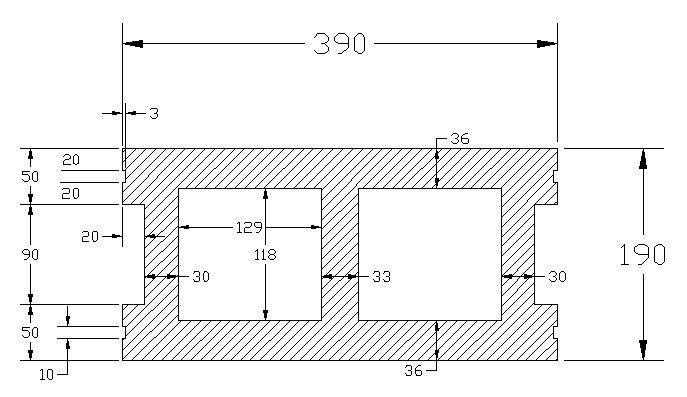
Note: Measure the inside dimensions of the block cavities. Subtract shell and web thicknesses from the overall block dimensions to get accurate inside measurements. It's recommended to add 5-10% extra concrete to account for spillage and minor measurement variations.
Quick Answer: How Much Concrete to Core Fill a Besser Block
For 190mm series besser blocks, you need approximately 0.04 m³ of concrete per square metre of wall (about 4 buckets per m²). For 290mm series blocks, it’s 0.064 m³ per m². A standard single besser block holds approximately 0.013 m³ of core fill — about 13 litres.
Enter your wall dimensions in the calculator above for an exact result, including wastage allowance.
Block Fill Calculator — Core Fill & Concrete Block Calculator Australia
Calculate how much concrete you need to fill block cores for besser block, concrete block, and masonry walls. Our free block fill calculator works for 90mm, 140mm, 190mm, and 290mm series blocks and gives you accurate volumes in cubic metres.
Core Fill Volume Per Block
| Block Size | Core Volume | Concrete Per m² | Blocks Per m² |
|---|---|---|---|
| 90mm series | 0.0008 m³ | 0.010 m³ | 12.5 |
| 140mm series | 0.0018 m³ | 0.023 m³ | 12.5 |
| 190mm series | 0.0032 m³ | 0.040 m³ | 12.5 |
| 290mm series | 0.0058 m³ | 0.073 m³ | 12.5 |
How to Calculate Block Core Fill
The block fill calculation formula is straightforward:
Total Core Fill (m³) = Number of Blocks × Core Volume per Block × 1.10 (waste factor)
Alternatively, if you know your wall area:
Total Core Fill (m³) = Wall Area (m²) × Concrete per m² × 1.10
Always add 10% for waste, spillage, and cores that are slightly oversize. For walls with many cut blocks or openings, increase the waste factor to 15%.
Block Fill Concrete Mix
Core fill grout is typically a flowable mix (slump 200-250mm): 1 part cement, 3 parts sand, 2 parts 10mm aggregate. Pre-mixed core fill (N20 grout) is available from most Australian concrete suppliers.
Core Fill Mix Ratios & Specifications
| Mix Type | Ratio | Strength | Best For |
|---|---|---|---|
| Site-mixed grout | 1:3:2 (C:S:A) | ~15 MPa | Small jobs under 1 m3 |
| N20 pump mix | Pre-batched | 20 MPa | Standard core fill |
| N25 structural | Pre-batched | 25 MPa | Reinforced/retaining walls |
| N32 high strength | Pre-batched | 32 MPa | Engineered walls, high loads |
Cost Estimates for Block Core Fill (2025)
| Method | Cost per m³ | Cost per m² (190mm) | Notes |
|---|---|---|---|
| Pre-mix bags (20kg) | $250-350 | $10-14 | Small jobs only |
| Ready-mix truck (N20) | $180-250 | $7-10 | Min order ~0.5 m3 |
| Pump + fill service | $280-400 | $11-16 | Includes pumping labour |
Prices vary by region. Metro areas typically lower than regional. Prices current as of early 2025.
Reinforcement Requirements per AS 3700
The Australian Standard for masonry structures (AS 3700) specifies when and how reinforcement is required in core-filled blockwork:
- Retaining walls: N12 vertical bars at 400-800mm centres depending on retained height. Starter bars from footing, lapped 500mm minimum
- Load-bearing walls: N12 bars at 800mm centres minimum for single-storey, 400mm for two-storey
- Boundary walls: N12 at each end, each side of openings, and at 1,200mm maximum centres
- Lintels: Core fill all bond-beam (lintel) blocks above openings with minimum 2 x N12 bars
- Top bond beam: Continuous N12 bar in bond beam at top of wall, minimum 2 bars for walls over 2m high
All reinforcement must have minimum 20mm cover to the face of the block. Grout must completely encapsulate the bar — vibrate or rod the grout in lifts of no more than 1.2 metres to avoid voids.
Step-by-Step: How to Core Fill a Block Wall
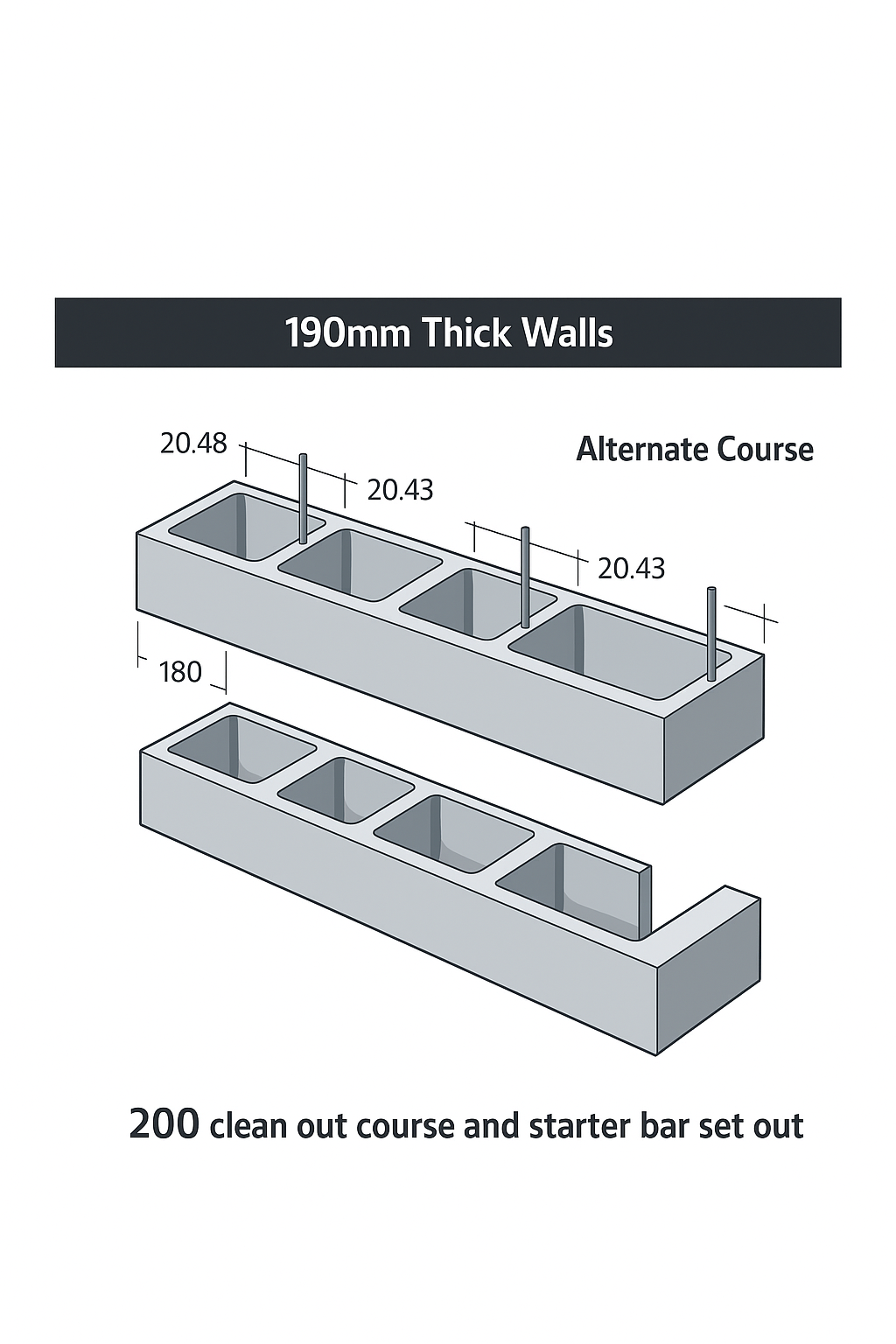
- Clean cores: Remove mortar droppings and debris from cores before filling
- Wet blocks: Pre-wet the block cores to prevent rapid moisture loss from the grout
- Place reinforcement: Insert starter bars and vertical reinforcement before grouting
- Pour in lifts: Fill cores in maximum 1.2m lifts. Allow each lift to settle before adding the next
- Consolidate: Rod or vibrate each lift to remove air pockets and ensure full encapsulation of reinforcement
- Top up: After settling, top up cores to the correct level before laying the next course
“The most common mistake with block core fill is not consolidating the grout properly. Air pockets around reinforcement reduce the structural capacity of the wall significantly. Always rod the grout and pour in manageable lifts.”
— Registered building surveyor, QLD
More than just calculators
Built Simple manages your entire project — estimates, schedules, tasks, and team.
Related Resources
Related Calculators
- Holes Calculator
- Concrete Volume Calculator
- Concrete Cost Calculator
- Retaining Wall Calculator
- Bricks Per M2 Calculator
Helpful Guides
Block Fill Calculator FAQ
What is block fill (core fill)?
Block fill is the concrete poured into the hollow cores of concrete blocks (besser blocks) to provide structural integrity. Required for retaining walls, load-bearing walls, and engineered designs per AS 3700.
How much block fill do I need per m²?
For 190mm series blocks (standard): ~0.04 m³ of concrete per m² of wall (approximately 4 buckets per square metre). For 290mm series: ~0.064 m³ per m². Always round up 5-10% for spillage.
What concrete mix for block fill?
Standard core fill is 20 MPa concrete with 10mm aggregate, slump 140-160mm to flow into cores. Higher MPa (25-32) for engineered retaining walls. Confirm with your structural engineer.
Blockfill vs core fill — same thing?
Yes, “blockfill” and “core fill” refer to the same product: concrete poured into block cores. Different states use different terminology (NSW/QLD often say “core fill”, VIC/SA “block fill”), but the spec is identical.
New on Built Simple
- Retaining Wall Block Calculator — full retaining wall takeoffs.

