
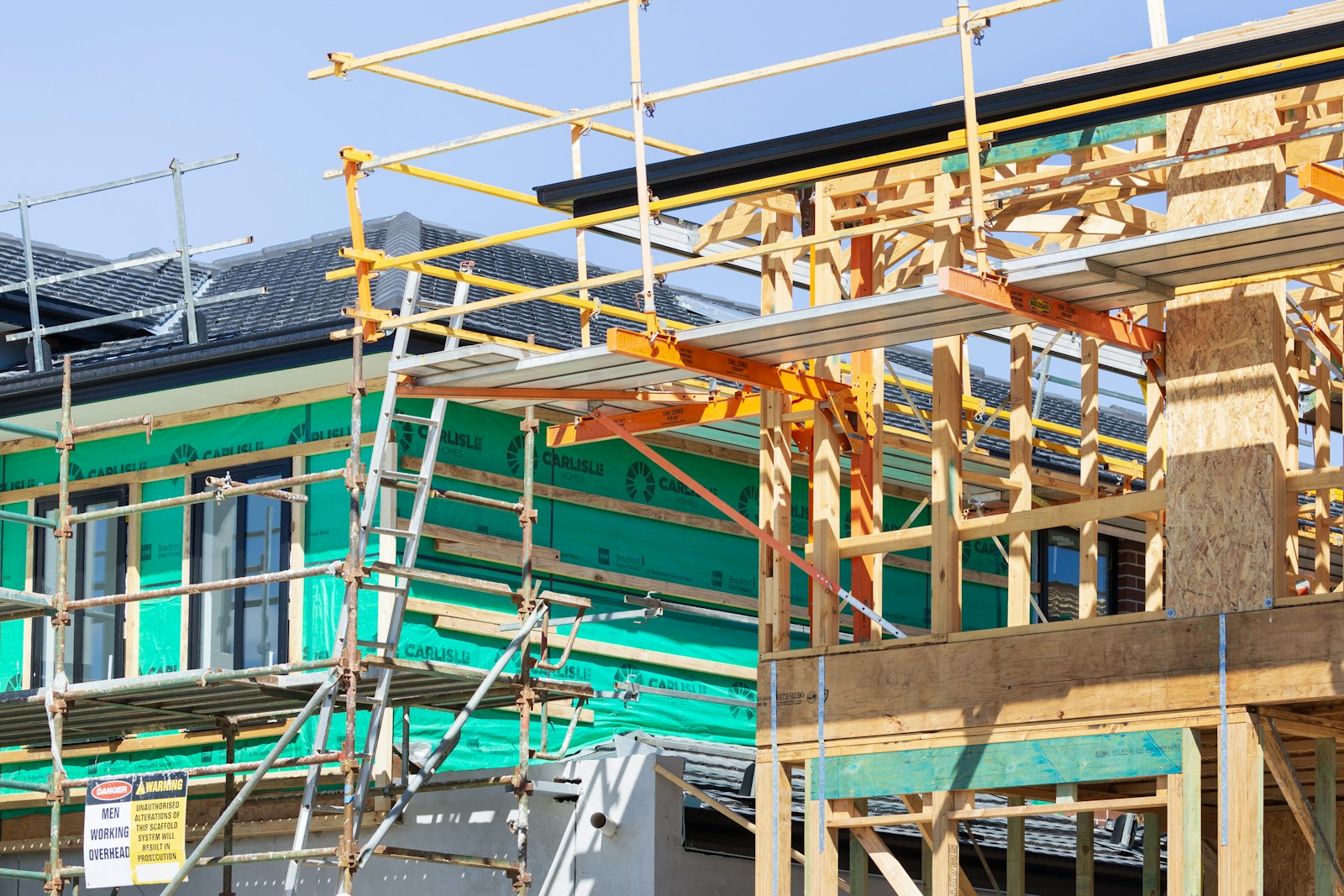
TL;DR: Markup and margin are not the same number. A 20% markup on costs gives you a 16.7% gross margin, and mixing the two up is one of the most common ways Australian builders quietly underprice work. There is no official published benchmark for a construction markup percentage in Australia, but commonly quoted industry ranges sit around 15 to 25% for residential builders, with volume builders often lower and small renovation and custom builders often higher. Whatever number you choose, it has to cover your real overheads first, then leave an actual profit, then have 10% GST added on top. Work it out from your own figures, not from what the bloke down the road reckons he charges.
If you have ever typed "construction markup percentage Australia" into Google at 9pm while finishing a quote, you are not alone, and you have probably noticed the answers are all over the shop. One site says 10%, another says 30%, and none of them explain whether that is markup or margin, on costs or on price, before GST or after. This guide sorts that out properly: the difference between markup and margin, the ranges Australian builders actually work in, what your markup has to cover and how to calculate a number for your own business instead of borrowing someone else's.
One thing up front. There is no law, standard or NCC clause that sets builder markup. Contract law and consumer law regulate how you charge in some states (cost-plus contracts have specific rules in most jurisdictions), but the percentage itself is a commercial decision. That is exactly why so many builders get it wrong: nobody hands you the number, so plenty of blokes inherit one from a previous boss and never check whether it still works.
Markup vs margin: they are not the same number
This is the single most expensive confusion in residential building, so let's nail it first.
Markup is the percentage you add to your costs. If a job costs you $100,000 in labour, materials and subbies, a 20% markup means you quote $120,000 (before GST).
Margin is the percentage of the sale price that is not cost. On that same $120,000 quote, your gross margin is $20,000 divided by $120,000, which is 16.7%, not 20%.
The two formulas:
- Margin = markup ÷ (1 + markup)
- Markup = margin ÷ (1 − margin)
Here is how the common numbers convert:
| Markup on cost | Gross margin on price |
|---|---|
| 10% | 9.1% |
| 15% | 13% |
| 20% | 16.7% |
| 25% | 20% |
| 33% | 25% |
| 50% | 33.3% |
Read that table twice, because the trap runs one way. If your accountant says the business needs a 20% gross margin to survive and you apply a 20% markup, you land at 16.7% margin and wonder where the money went. To hit a 20% margin you need a 25% markup. Every point matters when your margin is doing the heavy lifting on a $700,000 build.
What is a typical construction markup percentage in Australia?
Honest answer first: there is no official statistic. Neither the ABS nor any regulator publishes a standard construction markup percentage in Australia, and builders guard their numbers closely. What follows is what industry commentary, quantity surveyors' allowances and our own conversations with builders consistently suggest, so treat the ranges as orientation, not gospel.
- Volume and project home builders tend to run the lowest markups, often quoted in the 10 to 20% range, because they win on repetition and supplier buying power. Their net margins after overheads are famously thin.
- Small-to-medium residential builders doing custom homes, extensions and renovations commonly work around 15 to 25% markup on cost. Renovation work often sits at the top of that range or above it, because the unknowns are worse and the jobs are smaller.
- Trade contractors on small jobs often need 20 to 30% or more, because a $4,000 job carries nearly as much quoting, scheduling and admin as a $40,000 one.
- Cost-plus contracts in Australia commonly specify a builder's margin somewhere in the 15 to 25% range on top of actual costs, which is a useful public signal of what the market considers normal for open-book work.
Notice those ranges describe markup on direct cost, before GST. And notice what they do not tell you: whether that markup leaves any actual profit for the business, which depends entirely on your overheads. Which brings us to the part most quoting guides skip.
What your markup actually has to cover
Markup is not profit. Markup is the pool that pays for everything that is not a direct job cost, and only what is left after all of that is profit. Before a dollar reaches your pocket, your markup has to cover:
- Your own time off the tools. Quoting, site visits before you win the job, variations paperwork, chasing invoices. If quoting takes you four hours a job and you win one in three, every win carries twelve hours of unpaid estimating.
- Labour on-costs. An employee's real cost is well above the hourly rate on their payslip. Superannuation alone is 12% of ordinary earnings since 1 July 2025, then add annual leave, sick leave, public holidays, workers comp premiums and the unproductive hours between jobs. Award minimums under the Building and Construction General On-site Award set the floor, and Fair Work's pay tools will show you exactly what that floor is, but your quoted labour rate has to sit well above it to recover the on-costs.
- The business overheads. Ute and fuel, tool replacement, public liability and contract works insurance, domestic building insurance where required, licence and registration fees, accounting, software, phone, workshop or storage rent.
- Warranty and defects. The call-backs you do for free in year one come out of margin, nowhere else.
- Risk. Fixed-price contracts put cost escalation on you. A timber price jump between quote and frame stage is your problem, not the client's.
Add that lot up for a small crew and it is routinely tens of thousands of dollars a year before profit. If your markup does not clear it, you are paying for the privilege of building someone's house.
Why undercharging kills builders
Construction has led Australian insolvency statistics for years, and undercharging on fixed-price work is a big part of the story. The mechanics are worth spelling out, because a builder who underprices does not fail on quote day. He fails eighteen months later, and the lag is what makes it dangerous.
First, thin margins leave no buffer for cost movement. Through 2021 and 2022, ABS producer price index data showed home building costs rising at their fastest pace in decades. Builders holding fixed-price contracts signed at 2020 prices watched their entire margin, and then some, disappear into timber and steel. A builder on a 25% markup had room to absorb some of that. A builder on 12% was building at a loss by frame stage.
Second, undercharging compounds through cash flow. The underpriced job finishes short, so you lean on the deposit from the next job to pay the subbies from the last one. That works until the day it doesn't, and it takes otherwise good builders down with full order books.
Third, winning on price fills your pipeline with the wrong clients. The customer who chose you because you were $30,000 under the next quote will fight every variation, because price is the only thing they value. Meanwhile the estimating shortcuts that made you cheapest are exactly the gaps that surface as unclaimable extras mid-build. Accurate take-offs and honest allowances are the foundation under any markup, and if your estimating process is the weak link, start with our complete guide to construction estimation before you touch your percentage.
And costs keep moving upward for regulatory reasons too. NCC 2022's 7-star energy efficiency requirements added real cost to new homes, and compliance items like that must flow into your base estimate, with markup applied on top, not absorbed out of margin.
How to work out your own markup, step by step
Forget the bloke down the road. His overheads are not yours. Here is the calculation, with clean numbers as an example.
- Total your annual overheads. Everything from the list above that is not a direct job cost. Say it comes to $90,000.
- Estimate your annual direct costs. The labour, materials and subbie spend you expect to put through jobs this year. Say $600,000.
- Find your break-even markup. $90,000 ÷ $600,000 = 15%. At 15% markup you make exactly nothing. Every builder should know this number for their own business, and most don't.
- Add your profit target. Say you want $60,000 net profit for the year, on top of paying yourself a proper wage inside overheads. Now you need to recover $150,000 across $600,000 of costs, which is a 25% markup.
- Sanity-check the margin. A 25% markup is a 20% gross margin. Turnover lands at $750,000 ex GST, with $150,000 covering overheads and profit. If that margin makes you uncompetitive on every tender, the answer is usually to attack overheads or job type, not to quietly shave the markup and hope.
Then apply the markup consistently on every quote. If the process around this feels wobbly, our guide on how to quote a residential build in Australia walks through the full sequence from take-off to contract price.
Where GST fits, and where it doesn't
GST trips up more markup calculations than it should, so keep the rule simple: do all your markup and margin arithmetic on GST-exclusive numbers, then add 10% GST at the very end.
If you are registered for GST (compulsory once turnover hits $75,000, which is essentially every working builder), the GST you collect is the ATO's money passing through your account. It is not margin, and a quote that buries it can understate your position by 10% in one hit. Your cost inputs also need care: use ex-GST supplier prices in your estimate, because you claim those credits back.
On the quote itself, show the GST-inclusive total clearly, because a homeowner comparing quotes assumes the number they see is the number they pay. A consistent layout keeps this clean on every job, and our free construction quote template for Australian builders has the structure sorted.
Markup on materials, labour and subbies
Should everything carry the same percentage? Plenty of builders run a single blended markup for simplicity, and that is defensible. But there are fair arguments for splitting it:
- Materials carry procurement effort, delivery coordination, wastage and price risk. If you get trade pricing, the gap between your cost and retail is margin you have earned through your accounts, not something to give away. Getting quantities right matters just as much as the percentage, which is why we built tools like the free concrete calculator to tighten up the take-off end.
- Labour is where estimating error concentrates, since productivity varies job to job. Many builders carry their fattest contingency here rather than a fatter markup.
- Subcontractors arrive as a firm quoted price, so the risk is lower, and some builders apply a slightly lighter markup to subbie packages. Just never zero: you carry coordination, defects liability and payment risk on every subbie you engage.
Whichever way you split it, write the method down and apply it every time. Markup that moves with your mood is not a pricing strategy.
Frequently asked questions
What is a typical construction markup percentage in Australia?
There is no official figure. Commonly quoted ranges are roughly 15 to 25% markup on cost for residential builders, lower for volume builders and often higher for renovation specialists and trades on small jobs. Treat these as orientation only. The right number for your business comes from your own overheads and profit target, not an industry average.
Is a 20% markup the same as 20% profit?
No, twice over. A 20% markup is a 16.7% gross margin, and gross margin still has to pay all your overheads before anything counts as profit. A builder on 20% markup with heavy overheads can easily net low single digits.
Do I add markup before or after GST?
Before. Calculate costs ex GST, apply your markup, then add 10% GST to the total. Markup applied to GST-inclusive costs double-counts tax and muddies your margin tracking.
Should I show my markup on the quote?
On a fixed-price quote, no. You present a total price and the client decides on value. On a cost-plus contract the margin is disclosed by definition, and most Australian states have specific contract rules for cost-plus work, so use a compliant contract and get advice before offering it.
How do I raise my markup without losing every job?
Raise it on new quotes, not signed contracts, and pair the increase with a better quote: clear inclusions, realistic prime cost allowances and a professional document. Builders who present detailed, credible quotes give clients a reason beyond price to say yes. You will lose some price shoppers. Those were the jobs most likely to lose you money anyway.
The number is yours to set, so set it deliberately
The builders who last are not the cheapest and rarely the dearest. They are the ones who know their break-even markup to the decimal point and never quote below it awake or asleep. Do the overhead sum once a year, convert margin to markup properly and put GST on top at the end.
If you want the number-crunching side of quoting to take minutes instead of nights, the free Built Simple app has 45 calculators built for Australian trades, no signup required. Download it, run your next take-off on your phone and keep the markup maths honest from the start.
Related: Construction award pay rates: what this year’s changes mean for your quotes
Related: Construction scheduling: how to build a program that doesn’t blow out
Related: House extension cost Australia: the 2026 builder’s guide
Related: Construction award pay rates: what a builder collapse should make you re-check in your own numbers




