
TL;DR — What a retaining wall costs in Australia (2026)
- Timber (treated pine or hardwood sleepers): $100 – $250 per linear metre installed.
- Besser block (rendered or face): $200 – $450 per linear metre installed.
- Poured reinforced concrete: $300 – $700 per linear metre installed.
- Any wall over 1 m high typically needs council approval and engineering.
- Worked example: a 10 m long x 1.2 m high besser block wall in suburban Melbourne lands around $3,800 – $5,200 in 2026 once you factor in drainage and footings.
Retaining walls look simple from the kerb. They are not. The price you pay in 2026 is driven by three things stacked on top of each other: the material you choose, the labour and excavation needed to install it, and the height and engineering requirements your local council enforces. Get any one of those wrong on the quote and the project bleeds money fast.
This guide pulls together real 2026 Australian pricing for the three retaining wall types tradies and homeowners actually build — timber sleepers, besser block, and poured concrete — plus the labour breakdown, drainage rules, and the council triggers you cannot ignore. If you want to skip ahead and run your own numbers on block counts, jump to our free retaining wall blocks calculator.
The 3 retaining wall types in Australian backyards
Almost every residential and light commercial retaining wall in Australia falls into one of three categories. Each one has a different cost profile, a different lifespan, and a different sweet spot.
1. Timber sleeper walls (pine or hardwood)
Timber is the entry-level option. Treated pine H4 sleepers run cheap and install quickly — you dig post holes, set timber posts in concrete, then slot horizontal sleepers between them. Hardwood sleepers (red gum, ironbark, recycled railway timber) cost more but last longer in damp soil.
- Lifespan: Treated pine 15 – 20 years; hardwood 25 – 40 years.
- Best for: Garden beds, low retaining (under 1 m), terracing, rural blocks, owner-builder weekenders.
- Watch out for: Termite risk in untreated species, post rot at the soil line, walls that bow when drainage is skipped.
2. Besser block walls
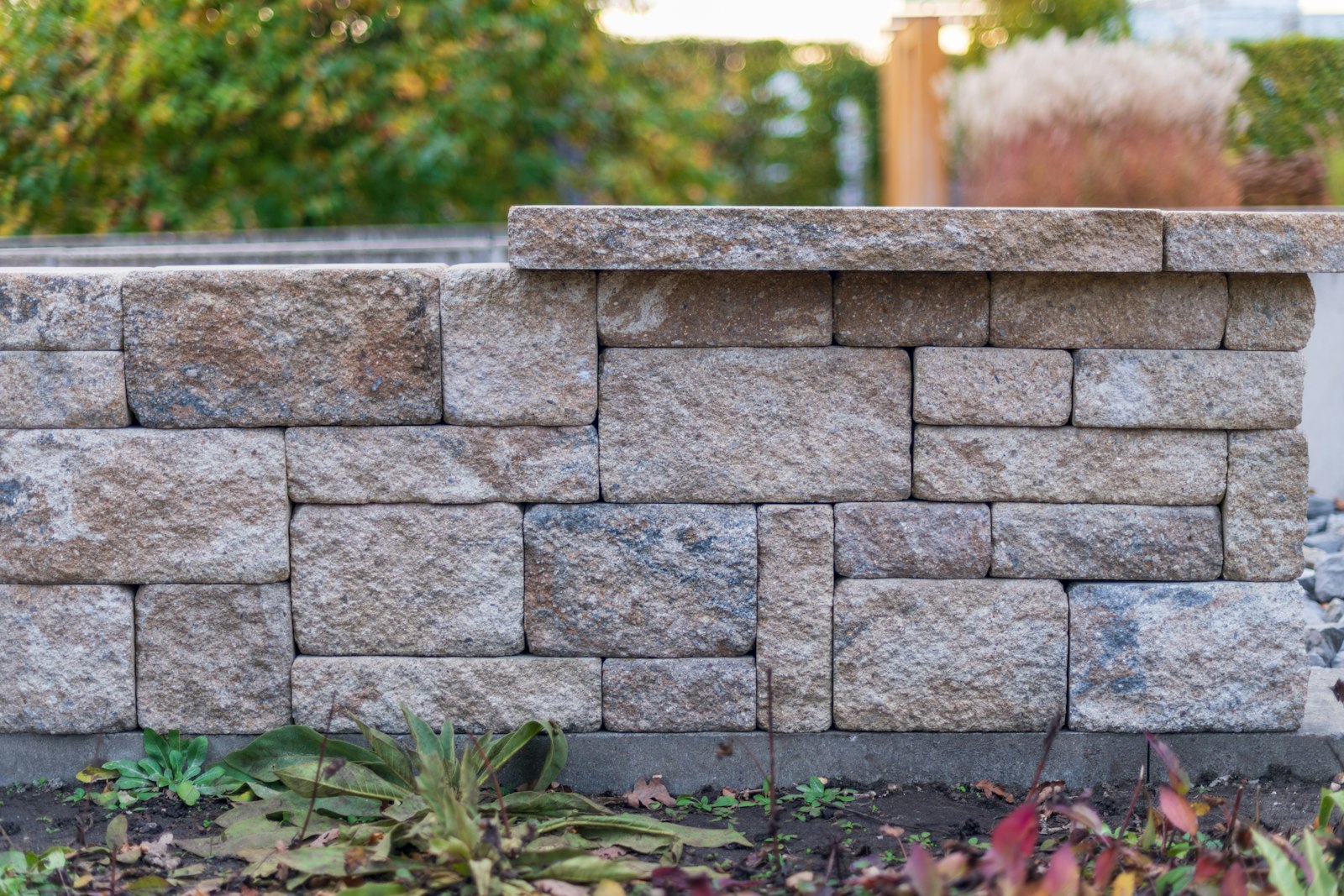
Besser block (also called concrete masonry block, CMU, or hollow blockwork) is the standard for medium-height retaining in suburban Australia. Blocks are laid course by course on a poured concrete strip footing, vertical reinforcing bar runs up through the cores, and the cores are core-filled with concrete. Finish options range from raw face block to rendered, painted, or stone-clad.
- Lifespan: 50+ years when built to AS 4678 with proper drainage.
- Best for: Walls 0.5 – 2.5 m high, driveways, pool surrounds, anywhere a wall doubles as a structural boundary.
- Watch out for: Skipping core fill, undersized footings, no Ag drain — all three cause efflorescence, cracking, and ultimately wall failure.
3. Poured reinforced concrete walls
Poured concrete is the premium option. You build a formwork box, tie in steel reinforcement to engineer’s specs, then pour the wall in one or two lifts. Finish is either off-form (smooth or board-marked) or rendered. This is what you use when the wall is tall, loaded by a driveway or building above, or in a high-water-table site.
- Lifespan: 75+ years.
- Best for: Walls over 1.5 m, walls supporting structures, basements, sloping coastal blocks.
- Watch out for: Form hire costs, concrete pump access, the fact that any error is locked in once you pour.
2026 cost per linear metre: side-by-side comparison
The table below is the headline number you came here for. These are installed prices in Australian dollars, including materials, footings, basic drainage and labour for a standard residential wall up to 1.2 m high. Prices climb steeply above 1.5 m because of engineering, reinforcement, and access. Regional and remote pricing runs 15 – 30% higher than metro.
| Wall type | Cost per linear m (installed) | Typical height range | Lifespan |
|---|---|---|---|
| Treated pine sleepers | $100 – $180/m | Up to 1.0 m | 15 – 20 years |
| Hardwood sleepers | $170 – $250/m | Up to 1.2 m | 25 – 40 years |
| Besser block (face) | $200 – $320/m | Up to 2.0 m | 50+ years |
| Besser block (rendered/clad) | $320 – $450/m | Up to 2.5 m | 50+ years |
| Poured reinforced concrete | $300 – $700/m | Up to 3.0 m+ | 75+ years |
Prices are 2026 metro Australia, ex-GST, for walls up to 1.2 m high on accessible flat sites. Add 20 – 40% for steep blocks, restricted access, engineering certificates, or removal of an existing wall.
Need to convert block count and footing volumes to a real material order? Run the numbers through our Retaining Wall Blocks Calculator — it accounts for block size, course count, and a 10% wastage buffer in seconds.
Where the money actually goes: labour cost breakdown
The headline per-metre price hides a lot of moving parts. On a typical besser block wall in suburban Melbourne, here’s roughly how a $350/m installed quote splits up.
| Cost component | Share of total | What it covers |
|---|---|---|
| Excavation & site prep | 15 – 20% | Bobcat, spoil removal, levelling, set-out. |
| Footing & concrete | 15 – 20% | Strip footing, starter bars, core fill mix. |
| Wall materials | 25 – 30% | Blocks, reo, mortar, ties, capping. |
| Labour (build) | 25 – 30% | Bricklayer day rate, leading hand, labourer. |
| Drainage & backfill | 8 – 12% | Ag drain, sock, scoria/gravel, geofabric. |
| Engineering & council | 3 – 8% | Cert, soil report, permit (over 1 m walls). |
Two takeaways:
- Labour and excavation together are roughly half the bill. Switching from a steep site with no truck access to a flat site with a bobcat path can swing the quote by thousands.
- Skimping on drainage is the most common — and most expensive — false economy. A blocked wall fails. Replacement is 3 – 5x the original price.
When you need council approval and engineering
Warning: the 1 metre rule
In most Australian councils, any retaining wall over 1 metre high (measured from natural ground level to the top of the wall) triggers a building permit, an engineer’s certificate, and usually a soil report. Some councils — particularly in steep or unstable areas — drop that threshold to 600 mm.
Building without approval doesn’t just risk a fine. If the wall fails or you sell the property, the buyer’s conveyancer will flag it and you may be ordered to demolish and rebuild to spec.
Even a sub-1 m wall can pull approval if it:
- Supports a driveway, building, swimming pool, or any structural load.
- Sits within 1 m of a property boundary.
- Is within a heritage overlay, bushfire (BAL), or significant landscape overlay zone.
- Forms part of a stepped series of walls totalling over 1 m in combined height.
Quick state-by-state council variations
- Victoria: Building Regulations 2018 — permit required over 1 m, or any wall loaded by a structure. Engineer’s certificate near-universal above 1 m.
- New South Wales: SEPP exempt and complying development covers many walls under 600 mm and not loaded; above that, a CDC or DA is needed.
- Queensland: Building Act 1975 plus local council overlays — the 1 m trigger is common but some councils (Brisbane, Gold Coast, Sunshine Coast) require notification at any height in flood / slip zones.
- WA, SA, TAS: Generally aligned with the 1 m rule, with engineer’s certification required for sites with reactive clay (very common in Adelaide and Perth foothills).
Always check your specific local council’s website before you quote a job — the variations are real and the penalties bite.
Drainage: the part you can’t skip
Water pressure (hydrostatic load) is the single biggest killer of retaining walls in Australia. A 1.5 m wall holding back saturated clay can experience over 1,000 kg of lateral pressure per metre of length. That’s why every wall above garden-bed height needs proper drainage.
The standard drainage stack
- Ag drain (agricultural pipe): 100 mm slotted/sock pipe laid along the base of the wall on the uphill side, fall 1:100 minimum, daylighted or piped to stormwater.
- Free-draining backfill: 300 mm minimum of 20 mm clean scoria or drainage gravel against the back of the wall, full height.
- Geofabric / filter sock: Wraps the gravel zone to stop fines from clogging the drain.
- Weep holes: On block and concrete walls, weep holes every 1.0 – 1.5 m at the base let any escaped water exit through the wall face.
- Compacted topsoil cap: Last 150 mm of backfill is compacted clay or topsoil to shed surface water away from the gravel column.
Budget around $30 – $60 per linear metre for drainage materials and the extra labour to install it correctly. It’s the cheapest insurance policy on the entire project.
Worked example: 10 m x 1.2 m besser block wall
Let’s price a realistic Melbourne backyard job: a single straight retaining wall, 10 metres long, 1.2 metres high, built in 200 mm core-filled besser block, finished rendered, with proper drainage. Flat site, normal soil, suburban access.
| Line item | Detail | Cost (AUD ex-GST) |
|---|---|---|
| Engineer’s design + certificate | Standard residential, no soil report | $650 |
| Council building permit | Victorian metro range | $420 |
| Excavation (bobcat + spoil out) | Half day plus tip fees | $680 |
| Strip footing (600 x 300 x 10 m) | ~1.8 m³ concrete + reo | $780 |
| Besser blocks (200 series) | ~120 blocks + capping | $540 |
| Core fill + N12 reo | ~0.9 m³ pump mix | $420 |
| Bricklayer labour (build) | 2.5 days, 2-up | $1,400 |
| Drainage stack | Ag pipe, scoria, geofabric | $480 |
| Render finish | 2-coat acrylic, 12 m² | $520 |
| TOTAL (delivered, ex-GST) | ~$5,890 | $5,890 |
That works out to roughly $589 per linear metre for this specific build — on the higher end of the besser block range because of the render finish, engineering, and permit. Strip out the render and you save about $520. Skip the engineering and council and you save a thousand — but you also build an illegal wall, so don’t.
Want to price your own wall fast? Plug your dimensions into the Retaining Wall Blocks Calculator for block counts, then run the concrete numbers through our Concrete Cost Calculator for footings and core fill.
DIY or hire a tradie? How to decide
The honest answer depends on three things: the height, your time, and your tolerance for risk if it fails.
| Scenario | Recommendation |
|---|---|
| Garden bed edging or terrace, under 600 mm | DIY confidently with treated pine sleepers or interlocking block. No permit, low risk. |
| Sleeper wall 600 mm – 1.0 m, flat site | DIY if you’re handy — expect 2 – 3 weekends. Hire a labourer for excavation. |
| Besser block wall, any height | Hire a bricklayer. Core-fill geometry, reo placement, and footing depth need to match the engineer’s drawing exactly. |
| Wall over 1.0 m, supporting load, or on a slope | Always hire a licensed builder. Engineer-designed, council-approved, insured. Non-negotiable. |
| Poured concrete wall | Always hire a concreter. Form hire, pour timing, and finish quality are not weekend skills. |
If you’re a landscaper or concreter running multiple retaining jobs across a season, the time you lose juggling quotes, materials and schedules on spreadsheets compounds fast. That’s exactly the admin gap Built Simple closes.
How to quote a retaining wall accurately (the 6-step method)
- Measure the wall. Length, height at each end, and any steps. Don’t guess heights from photos.
- Survey the site. Access width, slope, soil type, services (call Dial Before You Dig).
- Get the engineer’s drawing first for anything over 1 m. The footing size and reo schedule drive material orders.
- Run a materials take-off. Blocks, reo, concrete, drainage gear. Add 10% wastage. Our retaining wall blocks calculator and concrete block calculator handle this in seconds.
- Price labour by the day, not the metre for anything tricky. Difficult access destroys per-metre pricing.
- Add contingency. 10 – 15% for residential retaining is normal — rock, services, weather and changed scope are the usual culprits.
Build the wall, not the spreadsheet
Built Simple’s free Retaining Wall Blocks Calculator gives you block counts, course numbers and footing volumes in seconds — no signup, no fluff.
Frequently asked questions
How much does a 10 metre retaining wall cost in Australia in 2026?
For a standard 10 m wall, 1.0 m high: timber sleeper around $1,200 – $2,500, besser block $2,500 – $4,500, and poured concrete $3,500 – $7,000 installed. Add roughly 30 – 50% for each extra 0.5 m of height because of engineering and reinforcement.
Do I need council approval for a retaining wall under 1 metre?
Usually no — if the wall is not loaded by a driveway, building, pool, or surcharge, isn’t within 1 m of a boundary, and isn’t in an overlay zone. Always check your local council’s exempt-development rules before building, because some councils drop the threshold to 600 mm.
What’s the cheapest type of retaining wall?
Treated pine sleeper walls are the cheapest at $100 – $180 per linear metre installed for walls up to 1 m. They’re suitable for garden terracing and light retaining, but lifespan is only 15 – 20 years and they don’t suit loaded or wet sites.
How long does a besser block retaining wall last?
A correctly engineered besser block wall — with proper footings, core fill, vertical reo, and a working Ag drain — will easily last 50 years and often longer. The failure mode is almost always drainage neglect or skipped core fill, not the blocks themselves.
Why is drainage behind a retaining wall so important?
Saturated soil can exert over 1 tonne of lateral pressure per metre of wall length. Without an Ag drain and free-draining gravel backfill, that hydrostatic pressure pushes the wall outward and eventually cracks or topples it. Drainage adds roughly 8 – 12% to the cost and stops a $5,000 wall becoming a $15,000 replacement.
Can I use a calculator to estimate my retaining wall cost?
Yes. Built Simple’s Retaining Wall Blocks Calculator gives you block counts and course numbers instantly. Pair it with the Concrete Cost Calculator for footings and the Concrete Block Calculator for face-block jobs — together they give you a full materials estimate in under five minutes. It’s part of our library of 50+ free trade calculators built for Australian builders.
Built for Aussie builders
Built Simple is Australian construction project management software made for small and medium builders, tradies and owner-builders. Our free trade calculators are designed by builders, for builders — no signup walls, no ads, no dodgy lead-gen forms. If retaining walls are part of your weekly mix, the Retaining Wall Blocks Calculator is built for you.
Calum Buchanan is the founder of Built Simple, based in Melbourne. Built Simple was founded in August 2025 to give Australian builders simple, mobile-first project management software. Pricing in this guide reflects metro Australian rates current to 2026 and is intended as a general estimating guide — always confirm scope, soil and council requirements with a licensed builder and structural engineer for your specific site.




