
If you’ve ever stood at the bottom of a set of stairs and felt one tread that’s just slightly off — a riser 5 mm higher than the others, or a going that’s noticeably shallower — you know exactly how unforgiving stair geometry is. Get it wrong and you’ve got a building surveyor problem, an insurance problem, and a real trip-hazard problem all rolled into one. The good news: the maths behind a compliant Australian stair is genuinely simple once you know the rules.
This guide walks through how to use a stair calculator the right way — covering the 2R + G formula, the NCC 2022 rise and going limits, a full worked example for a 2,800 mm floor-to-floor rise, the most common mistakes that get pulled up at inspection, and when you should stop calculating and call a designer. Whether you’re a chippy setting out a new flight, an owner-builder costing a renovation, or just trying to sanity-check a quote, this is the reference you’ll come back to.
Quick formula — memorise this one
2R + G = 550-700 mm (NCC). Aim for 600-650 mm for a comfortable stair.
Where R = riser height (115-190 mm) and G = going depth (240-355 mm).
If you want to skip the maths entirely, jump straight to our free Stair Calculator — punch in your total rise and it returns NCC-compliant rise, going, stringer length and pitch in seconds.
What a Stair Calculator Actually Does
A stair calculator takes one critical measurement — the total rise (the vertical distance between finished floor levels) — and works out the rest of the geometry so that every step is the same height, every going is the same depth, and the whole flight sits within Australian NCC limits.
Specifically, a good calculator will return:
- Number of risers — how many steps you need
- Individual rise height — total rise divided by number of risers, in millimetres
- Going depth — chosen to satisfy 2R + G
- Total run (going length) — how far the flight projects horizontally
- Stringer length — the hypotenuse, used for ordering timber or steel
- Pitch (angle) — must stay under 36° for private dwellings
The reason it matters: by NCC rules, every riser within a single flight has to be identical (within roughly 5 mm construction tolerance), and so does every going. Get one wrong and the entire flight fails inspection. A calculator removes the rounding errors that creep in when you’re doing 2,800 ÷ 16 in your head on site.
The 2R + G Formula: Why It Exists
Stair safety research dating back to French architect François Blondel in the 1670s identified that human gait length stays roughly constant on stairs — about 600 mm per step. The 2R + G formula encodes that relationship: as the riser gets taller, the going needs to get shorter to keep the stride natural. As the riser drops, the going lengthens.
The National Construction Code mandates:
2R + G must be between 550 mm and 700 mm
That’s the legal envelope. But within that envelope, stairs feel very different. A 2R + G of 550 mm gives you a steep, tight stair (think attic ladder territory). A 2R + G of 700 mm gives you a long, shallow stair (think Parliament House front steps). The sweet spot most designers aim for is 600-650 mm — comfortable for adults, manageable for kids and elderly users, and easy to time when carrying tools or laundry.
NCC 2022 Stair Requirements: The Limits
For Class 1 buildings (private dwellings — what most calculators and most builders deal with day to day), the NCC Volume Two, Part H1D5 (formerly 3.9.1) sets these limits:
- Riser (R): minimum 115 mm, maximum 190 mm
- Going (G): minimum 240 mm, maximum 355 mm
- 2R + G: between 550 mm and 700 mm
- Pitch: maximum 36° from horizontal
- Maximum risers per flight: 18 (commercial Class 2-9 limits this further)
- Minimum risers per flight: 2
- Riser opening: openings between treads must not allow a 125 mm sphere to pass through (in dwellings with kids)
- Width: minimum 600 mm clear width for private stairs (most builders go 900-1,000 mm)
- Headroom: minimum 2,000 mm above the line of nosings
For Class 2-9 buildings (commercial, multi-residential, public), goings tighten to a 250 mm minimum and max 18 risers per flight is enforced more strictly. Industrial stairs covered by AS 1657:2018 are a different beast entirely — pitches up to 45° are allowed, but only for trained workers accessing plant or rooftops.
Want to skip the manual maths?
Our free Stair Calculator applies every one of these NCC limits automatically. Type your total rise. Get a compliant flight. No spreadsheet required.
Worked Example: A 2,800 mm Total Rise
Let’s run a real-world example end to end. You’re framing a single flight from a ground floor slab to a first-floor platform. Finished floor to finished floor is 2,800 mm. Here’s how a stair calculator (or you, doing it manually) works the numbers.
Step 1: Pick a number of risers
Start by dividing the total rise by an ideal riser height (around 175 mm is comfortable):
2,800 ÷ 175 = 16 risers
So you’re aiming for 16 risers. Always round to a whole number — you can’t have a half step.
Step 2: Calculate the exact rise height
2,800 ÷ 16 = 175 mm per riser
That sits comfortably between the 115 mm and 190 mm NCC limits. Tick.
Step 3: Solve for the going using 2R + G
Plug 175 into the formula and aim for the comfortable 625 mm middle of the range:
2(175) + G = 625
350 + G = 625
G = 275 mm
That sits between the 240 mm and 355 mm NCC limits. Tick.
Step 4: Work out the total run
A flight with 16 risers has 15 goings (the top step lands on the upper floor, which isn’t a going). So:
15 × 275 = 4,125 mm total horizontal run
That’s how far the flight will project from the bottom riser to the top nosing. Critical for working out whether the stair will fit your floor plan and where the landing needs to sit.
Step 5: Calculate the stringer length
The stringer is the hypotenuse of a right-angled triangle where the rise is 2,800 mm and the run is 4,125 mm:
Stringer = √(2,800² + 4,125²) = √(7,840,000 + 17,015,625) = √24,855,625 = 4,985 mm (≈ 5 m)
Order your stringer timber at 5.1-5.2 m to allow for cuts at top and bottom.
Step 6: Check the pitch
Pitch = arctan(2,800 ÷ 4,125) = arctan(0.679) = 34.2°
Under the 36° private-dwelling maximum. Tick. This stair is fully NCC-compliant.
That’s roughly six lines of arithmetic. A stair calculator runs all of it instantly the moment you change the total rise — which matters when you’re iterating because the floor plan changed or the slab came in 30 mm higher than the architect’s drawing.
Common Mistakes That Fail Inspection
Most stair failures aren’t dramatic. They’re small geometry slips that show up when the building surveyor pulls out a tape measure. Watch for these:
1. Uneven risers within a single flight. The classic. You forget the slab is 20 mm low at one end, install the stringer to suit, and now your bottom riser is 195 mm and the rest are 175 mm. Trip hazard, inspection fail, expensive rebuild. Always measure the actual finished floor level at top and bottom — not the slab, not the joists — and divide that.
2. 2R + G outside the 550-700 mm window. Usually happens when someone chooses a steep riser (190 mm) and a shallow going (240 mm). That gives 2(190) + 240 = 620 mm — fine on paper. But push the riser to 195 mm (max + 5 mm overage) and the going to 235 mm and you’re at 625 mm — still in range mathematically, but you’ve blown both the riser and going limits. Both have to pass independently.
3. Pitch over 36°. Steep stairs feel okay when you walk down them in good shoes carrying nothing. They become dangerous when someone older, smaller, or carrying laundry uses them. The 36° limit isn’t arbitrary — it’s the angle at which heel strike on the going still feels confident. Above it, people start gripping handrails to feel safe.
4. Forgetting the top step doesn’t count as a going. 16 risers means 15 goings, not 16. Easy to miss when you’re laying out chalk lines on a subfloor.
5. No allowance for the nosing overhang. If you’re adding a 25 mm nosing on each tread, the effective going stays the same but your stringer cuts change. Stair calculators usually treat going as the horizontal distance between nosings, which is the NCC definition.
6. Forgetting headroom. Maths can give you a perfect flight that won’t fit under a low ceiling or beam. Always check 2,000 mm minimum headroom measured vertically from the line of nosings.
7. Balustrade gaps. Stair geometry might be perfect but the balustrade fails if openings let a 125 mm sphere through. Worth running the numbers in our balustrade spacing calculator at the same time you’re sizing the stair.
When to Stop Calculating and Call a Designer
When you should call a pro
A basic straight-run stair is well within DIY-or-chippy territory. The minute geometry gets curved, irregular or commercial, the maths and the regs get specialist. Get a designer or qualified stair maker involved if any of the below apply.
Stair calculators handle straight flights brilliantly. They start to fall over for:
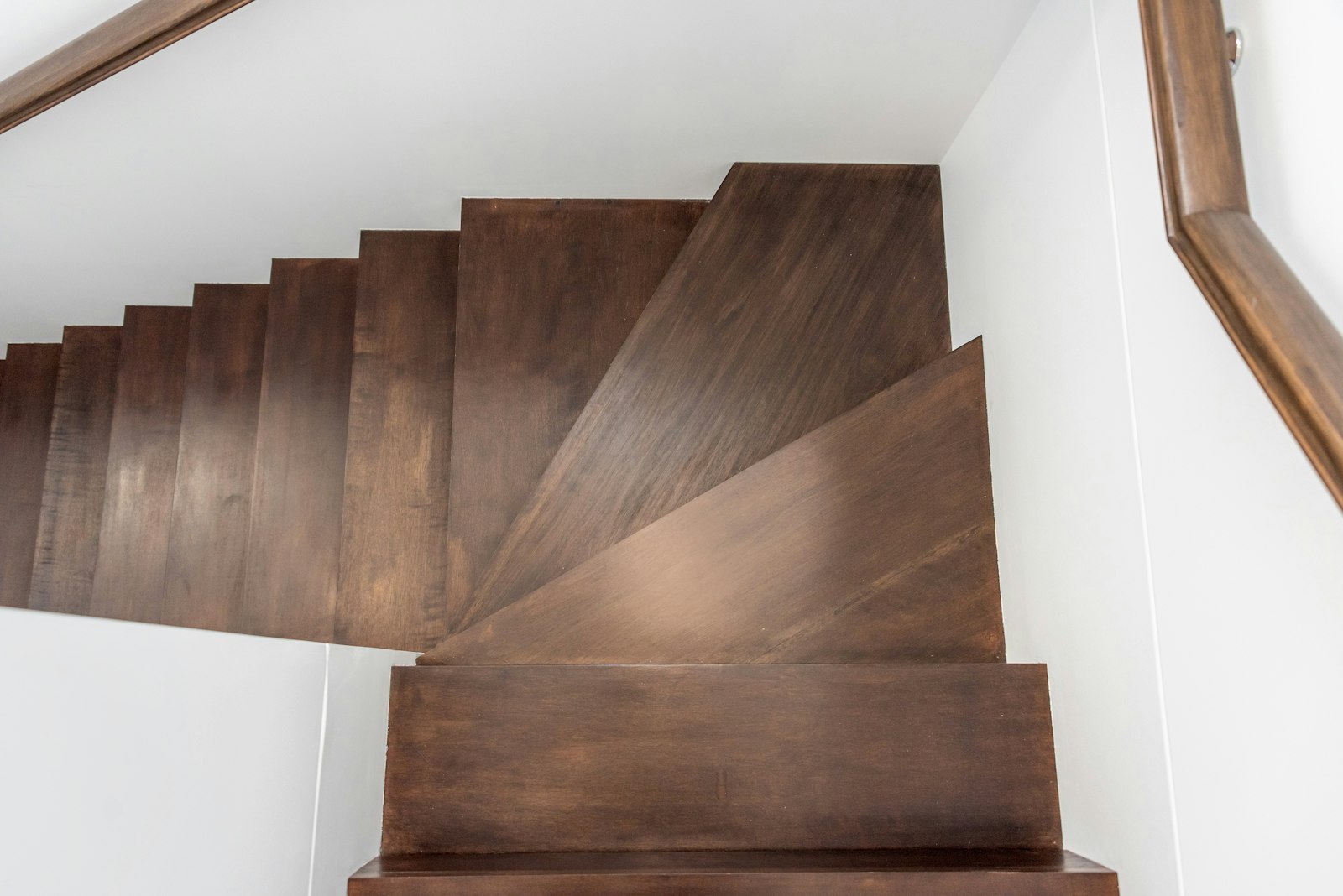
- Winders — tapered treads on a corner. Each tread has a different going on the inside and outside of the curve. NCC sets specific minimum goings at 270 mm from the inside string. Almost always needs a designer.
- Spiral stairs — covered by separate provisions in NCC and usually by AS 1657 when industrial. Pitch limits, central column diameter, balustrade rules all change. Get a spiral stair manufacturer involved early.
- Commercial Class 2-9 stairs — tighter going minimums, max 18 risers strictly enforced, additional accessibility requirements under AS 1428.1. Always design-reviewed.
- Stairs on accessible paths of travel — anywhere a person with a disability is reasonably expected to use the stair. AS 1428.1:2021 adds rules around contrasting nosings, tactile ground surface indicators, and handrail extensions.
- Curved or geometric stairs — anything that isn’t a straight or quarter-turn flight. The geometry isn’t linear and the calculator can’t help you.
- Industrial / rooftop / plant access — AS 1657:2018 governs. Different pitch limits, kick plates required, handrails both sides.
For the 90% of Australian residential jobs that are straight flights or simple quarter-landing layouts, a good stair calculator combined with the NCC 2022 limits above will get you to a fully compliant design in under a minute.
State Variations: Quick Notes
The NCC is adopted as the baseline by every Australian state and territory, but there are minor state-specific amendments worth checking before you lock in geometry on a real job:
- NSW — generally aligned with NCC; check Sydney Local Environmental Plans for heritage zones.
- VIC — VBA enforces the NCC; minor variation around mandatory licensing thresholds but not stair geometry.
- QLD — adopts NCC; flood overlay zones may dictate stair to upper levels.
- WA, SA, TAS, NT, ACT — NCC adopted with minor admin variations only.
The geometry rules — rise, going, 2R + G, pitch, headroom — are consistent across states. Always confirm with your local building surveyor for the project class and adopted NCC version.
How Built Simple’s Stair Calculator Works
Our Stair Calculator is free, mobile-friendly, and tuned specifically to the NCC 2022 limits for Australian Class 1 buildings. Type in your total rise (in millimetres) and it returns:
- Recommended number of risers
- Exact rise height per step
- NCC-compliant going depth
- Total horizontal run
- Stringer length for ordering timber or steel
- Pitch in degrees
- 2R + G value with a compliance check
It’s one of 50+ free construction calculators in the Built Simple library — covering concrete volumes, takeoffs, retaining walls, paint, tiles, flooring, and more. No login required, no data captured. They live alongside the full Built Simple construction management platform, which Australian builders, tradies and owner-builders use to run quotes, schedules and crews from their phone.
Stop doing stair maths by hand
Punch in your total rise. Get a compliant stair flight in seconds.
Frequently Asked Questions
What is the maximum riser height for stairs in Australia?
For private dwellings (Class 1 buildings) under NCC 2022, the maximum riser height is 190 mm and the minimum is 115 mm. Every riser within a single flight must be the same height (within roughly 5 mm tolerance). Commercial Class 2-9 buildings have the same 190 mm maximum but stricter design expectations.
What is the 2R + G rule for stairs?
The 2R + G rule is the slope-relationship formula in the NCC: twice the riser plus the going must total between 550 mm and 700 mm. It comes from research showing human stride length stays roughly constant on stairs. Designers typically aim for 600-650 mm because that range produces the most comfortable, natural-feeling flight.
How many steps can you have in a single flight in Australia?
For private dwellings (Class 1), NCC allows up to 18 risers per flight before requiring a landing. The minimum is 2 risers per flight. For Class 2-9 buildings, 18 is the firm maximum. Long stair runs that exceed 18 risers must be broken with an intermediate landing of at least the stair width in dimension.
What is the maximum angle (pitch) for stairs in Australia?
For private dwellings the maximum stair pitch is 36° from horizontal under NCC. For commercial Class 2-9 stairs it’s slightly tighter in practice because of the 250 mm minimum going. Industrial stairs governed by AS 1657:2018 may go up to 45°, but only where they serve trained workers accessing plant or rooftops.
Do I need a permit for new stairs in a renovation?
It depends on the scope. Replacing an existing flight with the same geometry usually falls under maintenance and doesn’t trigger a permit. Adding a new flight, changing the rise/going significantly, or building an external stair generally does require a building permit and certifier sign-off. Always check with your local council or private certifier — penalties for unpermitted structural work are significant in every state.
The Bottom Line
Designing a compliant Australian stair comes down to four things: pick a riser height between 115 mm and 190 mm, work out a going that satisfies 2R + G between 550 and 700 mm, stay under 36° pitch, and keep your rise consistent across the flight. Master those and you’re 95% of the way there. The remaining 5% — winders, spirals, commercial accessibility — is where you bring in a designer.
For everything else, use our free Stair Calculator. It’s tuned to NCC 2022, mobile-friendly, and free forever. While you’re there, check out the Balustrade Spacing Calculator for the handrail side of the build, browse the full library of 50+ free construction calculators, or — if you’re a chippy running multiple jobs at once — see how Built Simple helps carpenters quote, schedule and invoice from one mobile app.
Build it once. Build it right. Built Simple.




